
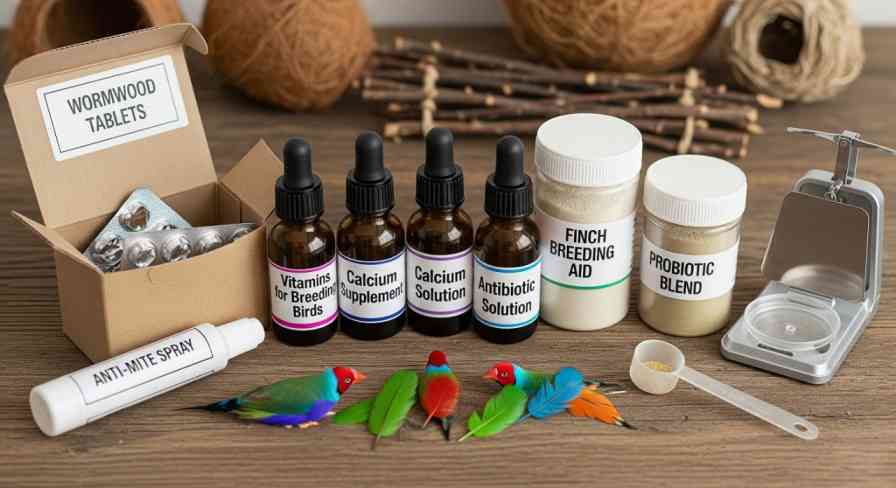
Welcome to the Gouldian Finch Breeding Medicine Course
Beneath the dazzling hues of the Gouldian finch lies one of nature’s most fragile masterpieces. With their radiant purples, electric greens, and sunset oranges, these birds look invincible—but seasoned breeders know the truth: a single draft, nutrient imbalance, or undetected parasite can end a breeding season before it starts.
That’s why this course exists. Not to dazzle you with exotic bird lore (though we’ll have plenty of that too), but to give you a roadmap—one built on real-world experience, scientific vet protocols, and a deep respect for the rhythms of avian life.
Whether you’re raising your first pair of Gouldians or managing a thriving aviary, this course will walk you through the complete lifecycle of Gouldian breeding, with a special focus on medical and nutritional management as the foundation of success.
🧭 What This Course Covers
This isn’t just a care guide—it’s your Gouldian breeding medical manual, organized like a seasonal field kit:
| Section | Focus |
|---|---|
| Species overview & readiness | How light, diet, and hormones shape reproductive timing |
| Nutrition planning | Feeding regimens tailored to breeding cycles |
| Disease prevention & treatment | From quarantine to protozoa, mites, and chick mortality |
| Emergency care | Egg-binding, wet nests, and first aid for breeders |
| Diagnostics & supplies | How to read droppings, pick medicines, and stock your med kit |
You’ll find charts, tables, case examples, and breeder-tested protocols throughout—plus embedded suggestions for equipment and products we actually use (yes, even from Amazon when it makes sense).
We’ll also link out to relevant breeder guides and deep dives from FinchGuy.com where useful.
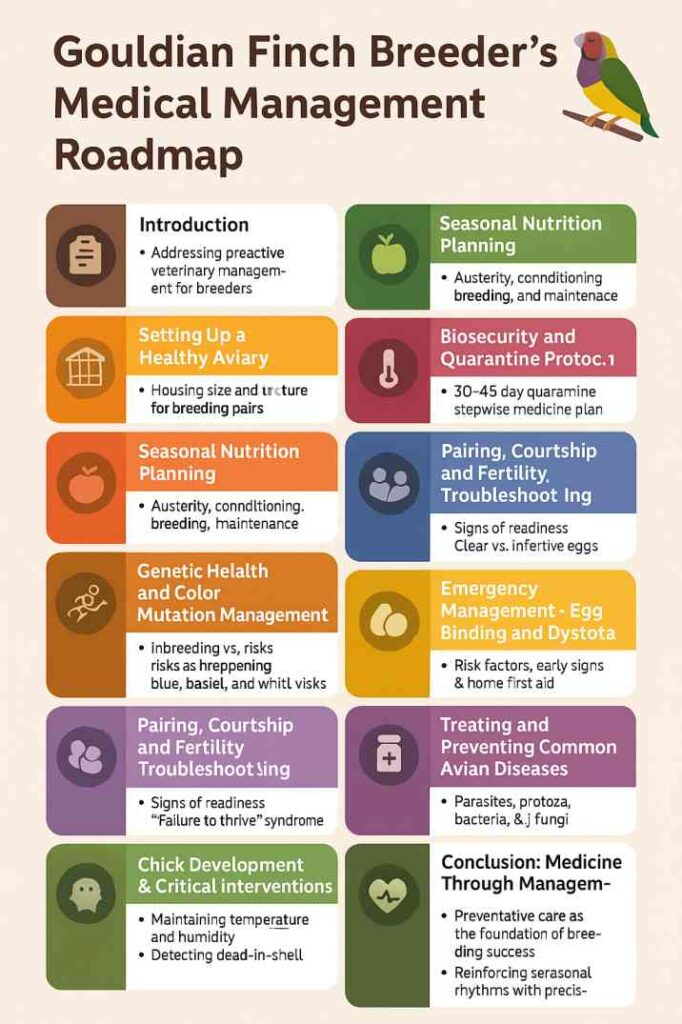
🩺 Why Medical Management Is the Missing Link
Most breeding failures aren’t random. They’re predictable—and preventable.
That infertile egg? Probably a protein imbalance or short photoperiod.
Those dead-in-shell chicks? Maybe low humidity or invisible coccidia.
That hen who died after laying? A calcium deficiency or undiagnosed egg-binding.
Too often, breeders focus on cages, colors, or mutations—while missing the root cause of loss: biology. This course shifts the focus back where it belongs: managing the Gouldian’s delicate physiology.
This means:
- Starting every season with a clean, medicated flock
- Understanding why diet phases matter
- Spotting early symptoms before a full-blown disease wrecks your colony
It’s not about throwing antibiotics into the water and hoping for the best. It’s about timing, observation, and precision care—skills you’ll learn step by step.
🧠 Who This Course Is For
Whether you:
- Just bought your first pair from a local breeder,
- Are expanding from zebra finches to something more exotic,
- Or run a serious breeding setup with dozens of cages—
You’re in the right place.
This course is built for real-world aviculturists, from beginner hobbyists to competitive show breeders. The information scales: start with the basics, or jump into advanced disease prevention strategies. Either way, you’ll leave with a complete framework to breed Gouldians with confidence and compassion.
🛠 Helpful Tools Before You Begin
You don’t need much to start—but having a few essential items on hand will set you up for success:
| Item | Why It Helps | Suggested Product |
|---|---|---|
| Full-spectrum bird light | Enables vitamin D₃ synthesis for calcium metabolism | Avian Sun 5.0 UVB Bulb + Fixture |
| Digital thermometer & hygrometer | Tracks aviary conditions to avoid egg loss | ThermoPro TP50 Monitor |
| Hospital brooder | Critical for saving egg-bound hens or sick chicks | Brinsea TLC-40 Eco Brooder |
| Calcium supplement (oral) | Prevents egg-binding & shell defects | Vetafarm Calcivet Liquid |
Ready to begin?
Let’s start with what makes the Gouldian tick—and why its wild Australian roots still matter in your climate-controlled bird room.
👉 Continue to: Species Overview & Breeding Readiness
🏡 Setting Up a Healthy Aviary
Where success begins: habitat as your first medicine
Before you ever see an egg, before your birds even sing their first courtship notes, you’ve already determined 80% of your breeding success.
It starts with the aviary.
A well-designed environment doesn’t just look nice—it keeps hens from becoming egg-bound, stops chicks from falling to their death, and prevents parasites from ever entering the flock.
So let’s build your space like it matters—because it does.
🪺 Housing Size & Structure for Breeding Pairs
You can’t force birds to breed. But you can give them a space where breeding feels natural, safe, and biologically possible.
Ideal Breeding Cage Dimensions (Per Pair):
| Cage Type | Dimensions | Notes |
|---|---|---|
| Breeding Pair Cage | Minimum: 24″ W x 18″ H x 18″ D | Horizontal space more important than height |
| Colony Aviary | 6’+ long, at least 3’ deep | Allow flight, separation, and territory |
| Flight Cage (non-breeding) | 36″–48″ wide | Ideal for exercise, not for nest setting |
- Dividers are your friend: During breeding, Gouldians get territorial. Separate pairs to reduce aggression and stress.
- No overcrowding: Even one extra pair in a shared space can destabilize the entire aviary.
👉 If you’re new to this, read FinchGuy’s guide on cage sizes for more depth.
🪵 Safe Perches, Substrate & Hygiene
Aviary health starts under your feet—and in your birds’ feet, too.
Perch Safety Checklist
✅ Vary perch thickness to exercise toes
✅ Avoid sandpaper covers (cause bumblefoot)
✅ Natural wood is best: manzanita, eucalyptus, or grapevine
✅ Place at different heights—but never above feeders or water
Amazon Pick: Natural Wood Perch Multi-Pack – offers 3 textures and safe chewing material.
Substrate Options – Pros & Cons
| Substrate | Pros | Cons |
|---|---|---|
| Paper liner | Cheap, easy to replace | Needs frequent changing |
| Corn cob | Absorbent, quiet | Can harbor mold if wet |
| Aviary-grade sand | Natural look, easy droppings detection | Must be kept dry to avoid fungus |
| Bare floor + tray | Simplest for cleaning | No insulation; may stress some birds |
🧼 Hygiene Rule: Clean trays, dishes, and perches at least weekly, preferably every 3–4 days during breeding. Use bird-safe disinfectants like F10 or diluted white vinegar.
📌 Tip: Keep two full sets of dishes and perches—rotate one in while cleaning the other.
😨 Preventing Injury, Contamination & Stress
Gouldians are drama queens in feathers—beautiful, but easily undone by change, crowding, or noise.
Stress Triggers to Eliminate:
- Sudden cage movements
- Overhandling during breeding
- Poor lighting cycles (too much or too little light)
- Sharp cage edges or loose wires
- Predator visibility (even a cat outside a window can stop breeding)
🔇 Use blackout curtains, consistent light timers, and quiet positioning to simulate their natural Australian breeding rhythm.
Contamination Sources:
- New birds without quarantine
- Unwashed seed or fresh greens
- Shared tools between cages
🧪 Always sanitize anything that touches multiple cages. For shared aviaries, consider an F10SC Veterinary Disinfectant—it’s safe, effective, and widely used in bird hospitals.
🧩 The Aviary as a Living System
Your breeding success isn’t just inside the birds—it’s in their space. Think of your aviary as a living, breathing system:
- Airflow supports respiratory health
- Perches shape muscle development and posture
- Lighting impacts hormones and eggshell strength
- Cleanliness is your first medicine
📍Need ideas for setting up your nest boxes? Check out the detailed breakdown in our Finch Nest Box Comparison Guide.
🛠 Quick Checklist Before Breeding Season Starts
| Task | Ready? |
|---|---|
| Breeding cages scrubbed, perches sanitized? | ✅ |
| Nest boxes installed, bedding prepped? | ✅ |
| Full-spectrum light on timer (14h/day)? | ✅ |
| Calcium & grit available? | ✅ |
| Sick bay/hospital cage prepped? | ✅ |
Next up: Seasonal Nutrition Planning—where we prepare your birds for breeding from the inside out.
Let me know if you’d like me to continue or create a graphic summary of this section!
🥬 Seasonal Nutrition Planning
Feed the season. Feed the purpose. Breed with success.
If the aviary is the stage, then nutrition is the script. No matter how clean your cages or how bright your lights, your Gouldians won’t breed—or survive the process—without purposeful, seasonal nutrition.
Wild Gouldians sync their reproductive cycle with nature’s script: seeds ripen, rains fall, protein surges, and breeding begins.
In captivity, you’re the weather. You control the seasons with your feeding plan.
🔄 The Four Dietary Seasons
Successful breeding starts long before the first egg. Here’s how to cycle your birds for health and fertility using the Austerity → Conditioning → Breeding → Maintenance model:
| Season | Purpose | Feeding Focus | Duration |
|---|---|---|---|
| Austerity | Resting phase; mimics dry season | Plain seed mix, no extras | 4–6 weeks |
| Conditioning | Prepares bodies for breeding | Add greens, protein, calcium | 2–4 weeks |
| Breeding | Supports egg-laying, chick feeding | High protein, soft food, supplements | Until chicks fledge |
| Maintenance | Recover and stabilize | Balanced diet, taper off soft food | Ongoing post-fledge |
📝 Pro tip: You can explore how breeders time these seasons by reading FinchGuy’s Breeding Calendar.
🧬 The Core Nutrients That Build Breeders
Without the following four nutrients, you’ll face everything from infertile eggs to dead-in-shell chicks and egg-bound hens.
1. Calcium (Ca)
Essential for shell formation, muscle function (egg-laying), and chick skeletal development.
| Source | Use |
|---|---|
| Cuttlebone | Free-access calcium |
| Vetafarm Calcivet Liquid | Emergency or daily boost |
| Crushed oyster shell | Mix into soft food or grit dish |
🛒 Vetafarm Calcivet – A must-have for all breeding setups.
2. Vitamin D₃
Enables calcium absorption. Without it, calcium supplements won’t work.
| Source | Note |
|---|---|
| Full-spectrum UVB lighting | Must be 12–14h daily |
| D₃-enriched supplements | Add to soft food or water during breeding |
| Direct unfiltered sunlight | Ideal but hard to regulate indoors |
📌 No UVB = no calcium uptake = egg-binding risk.
3. Iodine
Vital for thyroid function, hormone regulation, and chick development.
| Source | Use |
|---|---|
| Vetafarm Multivet | Add weekly to water |
| Iodized salt block | Use sparingly |
🛒 Vetafarm Multivet with Iodine is a breeder staple.
4. Protein
Crucial for egg formation, fertility, and chick growth.
| Season | Target Protein % |
|---|---|
| Conditioning | 15–17% |
| Breeding | 18–22% |
| Maintenance | 12–14% |
Protein sources:
- Soft food mix (egg, couscous, greens)
- Boiled egg & shell
- Soaked seed or sprouted seed
- Commercial breeding formula (e.g., Quiko, CeDe, or Higgins)
🛒 Higgins Egg Food is highly rated and easy to mix into daily feedings.
🌾 Seed vs. Pellet: Striking the Right Balance
Gouldians are picky—and most prefer seeds. But seeds alone are dangerously incomplete, especially during breeding.
| Food Type | Pros | Cons |
|---|---|---|
| Seed mix | Natural, encourages foraging | Low in vitamins/minerals |
| Pellets | Balanced nutrition | Often rejected by adults |
| Mix strategy | Best of both | Requires monitoring acceptance |
📝 Recommended approach:
- 70–80% seed-based staple
- 10–15% high-protein soft food (especially in breeding)
- 5–10% pellets or crumble, offered separately
- Multivitamins in water 1–2x weekly during breeding/condition
👀 See FinchGuy’s full Seed Mix Analysis for brand comparisons.
🧪 Sample Feeding Chart by Season
| Item | Austerity | Conditioning | Breeding | Maintenance |
|---|---|---|---|---|
| Finch seed mix | ✅ | ✅ | ✅ | ✅ |
| Greens (e.g., kale, dandelion) | ❌ | ✅ | ✅ | ✅ (lightly) |
| Boiled egg & shell | ❌ | ✅ | ✅✅ | ✅ (taper) |
| Iodine supplement | ❌ | ✅ | ✅ | ✅ |
| Soft food/egg mix | ❌ | ✅ | ✅✅ | ❌ |
| Probiotics | ❌ | ✅ | ✅ | ✅ |
| Pellets | ✅ | ✅ | ✅ | ✅ |
🚫 Feeding Mistakes to Avoid
❌ Too much protein post-fledging → fatty liver
❌ Excessive greens without gut support → diarrhea
❌ Calcium with no D₃ light → egg-binding risk
❌ Treating soft food like a treat instead of a tool
🧠 Bottom line: Breeding isn’t just an instinct—it’s a metabolic marathon. Feed them like athletes.
Ready to start pairing birds? Then let’s dive into the next module: Genetic Health and Color Mutation Management—where we tackle how to breed for beauty without breeding in disease.
🦠 Biosecurity and Quarantine Protocol
Protect your flock like your future depends on it—because it does.
They look fine. Alert. Curious. Eating well.
You just brought home two new Gouldians—gorgeous red-heads from a breeder three towns over. But what you can’t see could be fatal.
Canker. Mites. Coccidia. Air sac worms.
Any of these could already be riding in on your new arrivals. And once they touch your main flock, it’s too late to start being careful.
This is where biosecurity begins—not with fear, but with precision.
🧼 The 30–45 Day Quarantine Timeline
Quarantine isn’t just isolation—it’s a phased medical reset. During these 4–6 weeks, we eliminate hidden infections and help birds adapt without stress crashing their immune system.
🗓️ Quarantine Structure at a Glance:
| Day Range | Action | Purpose |
|---|---|---|
| Day 0–3 | Isolation + stress support | Acclimate, stabilize, observe |
| Day 4–7 | External parasite treatment | Eradicate mites/lice |
| Day 8–14 | Deworming | Kill roundworms/tapeworms |
| Day 15–21 | Antiprotozoals | Clear trichomonas, flagellates |
| Day 22–30 | Coccidiostat regimen | Stop coccidia before it spreads |
| Day 31–45 | Observation only | Ensure full health before integration |
📌 Use a separate cage in a separate airspace from your main aviary. Wash hands and tools after every contact.
💊 Step-by-Step Medication Plan
Each step builds on the last. Always follow product instructions and adjust dosages based on weight (Gouldians average ~14g).
Step 1: Stress Electrolytes + Probiotics
When: Days 1–3
Why: Travel stress weakens the gut and immune response.
What to Use:
- Avian Electrolyte + Vitamin mix
- Probiotic powder or liquid (like Vetafarm Probotic)
🛒 Try: Sav-A-Chick Electrolytes or Vetafarm Probotic
Step 2: External Parasite (Mite/Lice) Treatment
When: Days 4–7
Why: Even healthy-looking birds may carry feather mites, red mites, or lice.
What to Use:
- Ivermectin drop-on (0.1mL/100g)
- OR SCATT/Moxidectin topical
- Treat all perches and cage corners with permethrin or bird-safe spray
🛒 SCATT Mite Treatment – topical ivermectin for small birds.
Step 3: Deworming
When: Days 8–14
Why: Roundworms and tapeworms can remain asymptomatic for weeks, but reduce fertility and cause wasting.
What to Use:
- Wormout Gel (Vetafarm) in drinking water
- OR Piperazine for roundworms only
🛒 Vetafarm Wormout Gel – reliable and palatable for Gouldians.
Step 4: Antiprotozoals (Trichomonas/Hexamita)
When: Days 15–21
Why: Protozoa like canker live in the throat/crop and can go unnoticed until breeding.
What to Use:
- Ronidazole powder (10%) – in drinking water for 5–7 days
- Watch for: head shaking, gagging, or wet feathers under beak
🛒 Try: Ronivet-S or equivalent for flagellates
Step 5: Coccidiostat Treatment
When: Days 22–30
Why: Coccidia destroys gut lining, especially dangerous to chicks.
What to Use:
- Baycox (Toltrazuril) 2-day pulse treatment
- Repeat after 5 days if necessary
🛒 Baycox 2.5% – effective coccidiosis control
🧍♂️ Preventing Disease Introduction
Even with clean new birds, every day is a biosecurity day. Here’s how to protect your flock:
🚧 Core Practices
| Risk | Solution |
|---|---|
| Visitors entering aviary | Require foot bath or shoe covers |
| Shared feed scoop/tools | Sanitize between cages |
| Handling sick & healthy birds in same session | Handle healthy birds first |
| Outdoor exposure to wild birds | Cover air vents, monitor cage tops |
- Always have a hospital cage or brooder available for isolation.
- Never combine soft food bowls or water dishes between new and established birds.
🔐 Quarantine Isn’t Paranoia—It’s Prevention
Some of the worst breeding disasters come not from neglect, but from excitement—adding beautiful new birds without giving them the chance to stabilize.
Don’t treat quarantine like a delay. Treat it like a gate. Only the healthiest birds should pass through.
🧬 Genetic Health and Color Mutation Management
Because a beautiful bird isn’t worth a broken line.
Every Gouldian breeder knows the moment: you peek into the nest box and see that flash of sky blue or the icy shimmer of a white chest chick. It’s thrilling. It’s addictive. And—if you’re not careful—it’s dangerous.
When color becomes the goal instead of health, your birds pay the price.
🌿 Inbreeding vs. Hybrid Vigor
The gene pool is not a pond. It’s a river—you want it flowing.
Gouldians have been selectively bred for decades—sometimes by passionate hobbyists, sometimes by careless mass producers. That means some lines are incredibly strong… and some are genetic landmines.
❌ What Happens with Excessive Inbreeding:
- Stunted growth
- Infertility or low hatch rates
- Lethargy and weak immune systems
- Poor parenting instincts
- Shortened lifespan
On the flip side:
✅ Benefits of Hybrid Vigor:
- Larger clutch sizes
- Faster fledging
- Better resistance to coccidia and parasites
- Higher chick survival rate
Best Practice: Line-breed sparingly (1st cousins at most) and always outcross every 2–3 generations.
📌 Tip: Use a simple breeding record system. FinchGuy has a free Breeding Log Template to track genetic pairs and avoid accidental inbreeding.
🎨 The Mutation Minefield: Blue, Pastel, White
Color mutations can be stunning—but every mutation has a price tag in hidden weaknesses. Knowing this lets you breed with purpose, not just for novelty.
🚨 High-Risk Mutations Overview:
| Mutation | Risks | Notes |
|---|---|---|
| Blue | Fragile chicks, lower fertility | Avoid homozygous blue-to-blue pairings |
| Pastel | Weak feathers, high chick loss | Best as single-factor only |
| White Chest | Higher egg-binding risk in hens | Pair to normal chest when possible |
📉 Breeding blue-to-blue birds consistently results in weaker immune systems and high chick mortality—not because of bad care, but because of compromised biology.
Remember: Mutation ≠ improvement. It’s a change. Sometimes beautiful, sometimes lethal.
🧩 How to Breed for Color and Health
The goal is sustainable beauty—striking birds that don’t just survive, but thrive.
🧠 Smart Color Breeding Strategies:
- Use split birds (carriers) instead of doubling up mutations
- Cross to wild-type normals every 2 generations to refresh vigor
- Track pairings religiously—avoid stacking color mutations blindly
- Prioritize phenotype health—a dull but thriving bird is more valuable than a bright but sterile one
📘 Sample Pairing Plan:
| Male | Female | Goal | Outcome |
|---|---|---|---|
| Blue SF Normal | Normal Hen | Strengthen line | 50% carriers |
| White Chest SF | Normal Chest | Retain color, add vigor | Reduced chick loss |
| Pastel SF Cock | Wild-type Hen | Reintroduce vitality | No pastel double-factor risk |
⚖️ Balancing Color and Survival: A Breeder’s Mantra
Let’s be clear—there’s nothing wrong with loving color. That joy is why most of us got started. But the birds don’t care what they look like. They care whether they can fly, feed their chicks, and stay alive.
So ask yourself with every pairing:
- Are these birds strong enough to raise their young?
- Am I pairing for beauty at the expense of function?
- Will this line survive three generations from now?
Because legacy matters more than any single chick.
💕 Pairing, Courtship, and Fertility Troubleshooting
Because love songs don’t always end in chicks.
You’ve done everything right:
Perfect lighting. Balanced nutrition. A healthy aviary.
Then you check the nest box—clear eggs. Again.
Frustrating? Yes. Fixable? Absolutely.
In this module, we’ll decode mating behavior, help you ID compatible pairs, and walk through the big three infertility culprits: pairing mismatches, nutrition errors, and light cycle misfires.
🕊️ Signs of Readiness & Compatibility
Not all birds are ready to breed just because you are.
✅ Signs your Gouldians are ready:
| Behavior | Meaning |
|---|---|
| Male bobbing and singing with fluffed chest | Hormonal readiness and courtship |
| Female crouching or leaning forward when male sings | Acceptance signal |
| Nest investigation and shredding paper | Pair bond forming |
| Feeding each other (allopreening) | Bond reinforcement |
❌ Warning signs of incompatibility:
| Behavior | What It Means |
|---|---|
| Constant squabbling or chasing | No bond or mismatched pair |
| Ignoring one another | No hormonal readiness or species mismatch |
| Nest destruction or abandoned eggs | Psychological or hormonal mismatch |
📌 Tip: If a pair shows zero interest after 2–3 weeks, separate and try new combinations. Some birds simply don’t like each other.
🔍 Fertility Check: Candling and Interpreting Eggs
By day 5–6 after the first egg is laid, you should see signs of development when candling.
| Appearance | Diagnosis |
|---|---|
| Clear (light shines straight through) | Infertile or undeveloped |
| Visible red veins or black dot | Developing embryo |
| Blood ring (red ring, no veins) | Early embryo death |
| Rotten egg, smell, or weeping shell | Bacterial contamination |
🧪 How to Candle:
- Wait until day 6–8
- Use a high-intensity LED flashlight
- Candle quickly, avoid shaking
- Always wash hands before/after
👀 Want candling visuals? Check FinchGuy’s Candling Guide for real examples.
🧠 Why You’re Getting Clear Eggs (and What to Fix)
Clear eggs don’t mean your birds are broken—but they’re asking for something. Here’s how to troubleshoot the big three:
🥬 1. Nutritional Imbalance
- Low Vitamin E → Poor fertility in males
- Calcium or D₃ deficiency → Incomplete ovulation or thin eggshells
- Low protein during conditioning → No hormonal trigger for breeding
📌 Fix:
- Add Vetafarm Breeder’s Blend or similar supplement
- Boost protein to 18–22% during conditioning
- Offer egg food daily during pairing and egg-laying
💡 2. Light Cycle Issues
Gouldians rely heavily on daylight cues for hormonal stimulation. Too short or irregular lighting can halt ovulation entirely.
| Setup | Recommended |
|---|---|
| Daylight hours | 13–14 hours |
| Bulb type | Full-spectrum (UVB essential) |
| Timer | Yes – for consistency |
| Gradual increase? | Start at 12 hours and build up during conditioning |
🛒 GE Avian Sunlight Bulb with UVB spectrum is a favorite among breeders.
💔 3. Pairing Problems
Even with perfect diet and light, some pairs just won’t produce.
| Issue | Signs | Fix |
|---|---|---|
| Two hens | Nest building, no fertile eggs | Observe behavior & vent sex |
| Same mutation (blue-to-blue) | Weak sperm, embryo loss | Pair with a normal or split |
| Old or very young male | No courtship, infertile eggs | Replace cockbird (12–18 months ideal) |
🧠 Tip: Use split males for color and strength. Don’t double up high-risk mutations in both parents.
🛠️ When All Else Fails: Reset the Pair
Still getting clears? Try a reset protocol:
- Separate birds for 7–10 days
- Remove all nests
- Switch seed mix to austerity blend (no egg food, no greens)
- Reintroduce gradually with conditioning diet
- Re-pair with fresh nesting material and observe courtship
Often, this helps “reboot” hormonal pathways and leads to successful laying.
🧬 Final Thought: Fertility Is Fragile—But Fixable
Breeding Gouldians is an art form: light, food, behavior, and biology all need to align. But the reward is more than just chicks—it’s confidence in your flock’s health and in your own hands as a breeder.
Coming up next: Module 7 – Nesting, Egg Monitoring, and Chick Development, where we’ll track what happens after the egg—from pip to perch.
Let me know if you’d like me to turn this module into a fertility troubleshooting flowchart!
🥚 Emergency Management – Egg Binding and Dystocia
Because even the strongest hen can stall.
There’s a stillness that doesn’t feel like sleep.
A hen at the bottom of the cage, puffed, eyes half-shut.
You see her tail pulsing—rhythmic straining.
She’s not sick.
She’s stuck.
This is egg binding, also known as dystocia—a potentially fatal emergency that every serious breeder will face at some point. What you do in the next 60 minutes could save her life.
⚠️ Understanding the Risks: Why It Happens
Egg binding isn’t random. It’s almost always the end result of compounding risk factors. Knowing them lets you prevent most cases before they start.
🧬 Top Risk Factors:
| Cause | Examples |
|---|---|
| Calcium or Vitamin D₃ Deficiency | Poor diet, no cuttlebone, no UVB light |
| Young or old hens | <8 months or >4 years |
| Over-conditioning | Too much protein, breeding too frequently |
| Genetic lines | White chest and pastel hens more prone |
| Cold or stress | Sudden temp drops, disturbance during laying |
| Infection or malpositioned egg | Rare, but serious |
📌 If your hen has laid soft-shelled or malformed eggs before, she’s already flagged as high-risk.
👀 Early Warning Signs You Can’t Ignore
Catching the signs early gives you time to act before the bird enters shock. Don’t dismiss these behaviors:
| Sign | Meaning |
|---|---|
| Fluffed feathers, lethargy | General distress or discomfort |
| Repeated tail bobbing | Straining to lay |
| Wide-legged stance or wobbling | Pelvic pressure |
| Heavy breathing, closed eyes | Approaching collapse |
| No egg after 24+ hours of visible labor | Confirmed egg binding |
🕵️ Confirm With Gentle Palpation:
- Use two fingers and gently feel the lower abdomen (just above the vent)
- A firm, rounded lump = likely egg
- No mass, but symptoms? May be internal laying or cloacal prolapse
🧰 Immediate Home First-Aid Protocol
This emergency kit should always be on hand during breeding season:
| Item | Use |
|---|---|
| Heat source (infrared lamp or heating pad) | Loosens muscles, reduces shock |
| Calcium gluconate (oral or injectable) | Restores uterine contractions |
| Electrolyte + glucose solution | Revives energy |
| Coconut oil or KY jelly | Lube for cloaca (DO NOT insert fingers) |
| Hospital cage or brooder | Isolation and warmth |
🩺 Step-by-Step Emergency Care
DO NOT attempt to manually remove the egg unless trained—it causes tears, ruptures, and often death.
- Isolate and Warm
- Place bird in hospital cage
- Maintain ambient temp at 30–32°C (86–89°F)
- Administer Calcium
- Calcium Gluconate 23% oral: 0.1–0.2 mL via syringe to beak
- Repeat in 2–3 hours if no improvement
- Optional: add liquid vitamin D₃ (1 drop) to water
- Hydrate
- Offer electrolyte solution (Sav-A-Chick or homemade mix)
- Dab a droplet on beak tip every 30 minutes if not drinking
- Lubricate Vent (if straining)
- Dab small amount of coconut oil or KY Jelly around cloaca
- DO NOT use Vaseline or oils with fragrance
- Wait and Monitor
- If egg is not passed in 4–6 hours, or bird worsens: escalate
🛒 Essentials:
- Calcium Gluconate 23%
- Sav-A-Chick Electrolyte Packets
- Small Animal Brooder
🏥 When to Escalate to a Vet
If you see any of the following, your bird needs immediate veterinary support:
| Symptom | Risk |
|---|---|
| No egg passed after 6–8 hours of care | Possible obstruction |
| Blood at vent or prolapse | Internal tear |
| Hen collapsing, gasping | Shock, organ failure |
| Foul smell from vent | Egg rupture or infection |
Vet Interventions May Include:
- Injectable calcium and oxytocin to stimulate expulsion
- Manual egg removal with sedation
- Surgical removal in worst cases
- Antibiotics if infection is suspected post-binding
Even experienced breeders lose birds to egg binding. But fast response can turn a crisis into a recovery.
🛡️ Prevention: The Real Goal
The best emergency is the one that never happens.
💪 Year-Round Prevention Checklist:
- ✅ Daily access to cuttlebone and iodine block
- ✅ Full-spectrum lighting with UVB for D₃ synthesis
- ✅ Calcium and mineral boost before and during laying
- ✅ Allow only 2–3 clutches per season, with rest periods
- ✅ Avoid pairing hens under 8 months or over 4 years
🐣 Incubation, Hatching, and Nest Monitoring
From hopeful egg to chirping heartbeat.
The moment your finch lays an egg, a silent countdown begins. Inside that tiny shell, a new life stirs, fragile and vulnerable. As a breeder, your role shifts to guardian—setting the stage, watching the clock, and knowing when to intervene or simply trust nature’s rhythm.
🌡️ Perfect Conditions: Temperature and Humidity Essentials
Gouldian finch eggs need a steady, cozy environment to develop healthily. Even small fluctuations can delay hatching or cause embryo death.
| Parameter | Ideal Range | Why It Matters |
|---|---|---|
| Temperature | 37.5°C ± 0.3°C (99.5°F) | Maintains steady embryonic metabolism |
| Humidity | 50–60% relative humidity | Prevents egg dehydration or oversaturation |
Tips to Keep Your Aviary Nest Stable:
- Use a digital thermometer/hygrometer near the nest to track microclimate.
- Avoid direct drafts or heating sources that cause hot/cold spots.
- Add a shallow water dish nearby to increase ambient humidity if too dry.
- Monitor especially in dry seasons or air-conditioned rooms.
🔍 Spotting a Successful Hatch vs. Trouble
Not every egg hatches. Understanding failure types helps adjust your practices and avoid repeating mistakes.
| Outcome | Signs | Causes |
|---|---|---|
| Fertilized but dead-in-shell | Embryo died mid-development; visible blood vessels but no movement; discoloration | Poor incubation environment; infection; genetic issues |
| Unfertilized egg | No blood vessels or embryo development; clear or white appearance | Incompatible pairing; infertile male or female |
How to Check Eggs:
- Candling: Hold egg up to bright light in a dark room after 7-10 days
- Look for veins and embryo movement
- No development? Mark as infertile and remove after full incubation period
🦠 Salmonella and Mold: Hidden Threats to Embryos
Eggs are fragile ecosystems. Unsanitary conditions or moisture buildup can foster dangerous pathogens.
Risks:
- Salmonella: Can infect eggshell, penetrate pores, causing embryo death or hatchling illness.
- Mold: Thrives in damp nests, suffocates embryos, causes shell discoloration.
Prevention Checklist:
- Clean nests thoroughly between clutches with bird-safe disinfectant.
- Replace substrate regularly to prevent moisture buildup.
- Keep humidity balanced—not too high to encourage mold.
- Avoid overcrowding nests or aviaries to reduce contamination.
📊 Embryo Mortality Causes (Approximate Breakdown)
| Cause | Percentage Estimate |
|---|---|
| Incubation temperature | 40% |
| Infection (Salmonella/mold) | 25% |
| Genetic/fertility issues | 20% |
| Handling or environmental stress | 15% |
By mastering incubation and nest care, you give your Gouldians the best chance to grow from fragile eggs into strong, vibrant finches ready to fill your aviary with song.
🐤 Chick Development & Critical Interventions
From tiny fluffball to confident fledgling.
The first days after hatching are some of the most thrilling — and nerve-wracking — moments in Gouldian finch breeding. Watching those fragile chicks grow and thrive feels like witnessing a miracle. But it’s also a critical period where close observation and swift action can make all the difference.
⏳ Key Milestones: Hatch to Fledging
| Age (Days) | Developmental Milestones | Breeder’s Focus |
|---|---|---|
| 0–7 | Hatchlings are naked, eyes closed, fully dependent on parents for warmth and food | Keep nest warm and clean; ensure parents are feeding adequately |
| 8–14 | Down feathers develop; eyes open around day 10; begin slight movement in nest | Monitor feeding frequency and chick activity; watch for signs of weakness |
| 15–21 | Feather growth accelerates; chicks start wing flapping; pre-fledging behavior appears | Gradually prepare aviary for fledging; maintain hygiene; observe parent-chick interactions |
| 22+ | Chicks fully feathered; fledging occurs between days 22–28 | Provide safe flight space; monitor diet transition to seeds |
⚠️ “Failure to Thrive” Syndrome: Causes and Diagnostic Steps
Sometimes chicks don’t grow as expected despite seemingly good conditions — a frustrating and heart-breaking situation. Understanding underlying causes is key to turning things around.
| Common Causes | Signs | Diagnostic Actions |
|---|---|---|
| Poor parental quality (inexperience, illness) | Chicks weak, underfed, lethargic | Observe parental feeding behavior; consider fostering with experienced adults |
| Subclinical infections (e.g., Cochlosoma) | Persistent diarrhea, weight loss, fluffed feathers | Collect fecal samples; consult avian vet for parasite testing |
| Hygiene issues (dirty nests, contaminated food) | Bad odor, visible droppings buildup, mold in nest | Thoroughly clean nest and aviary; replace substrate; improve sanitation |
| Nutritional deficiencies | Stunted growth, deformities, weak muscles | Review and adjust breeder’s diet; consider supplements (calcium, vitamins) |
👩👧👦 Parental Quality and Hygiene Impact
Successful chick rearing is not just about the chicks themselves — the parents’ health and behavior are equally crucial.
- Experienced parents feed more consistently and detect chick distress faster.
- Clean nests and feeders reduce risk of infections that can silently undermine chick health.
- Subclinical infections, such as Cochlosoma (a protozoan parasite), often go unnoticed but can cause chronic diarrhea and poor growth.
Diagnostic Flowchart: When Chicks Fail to Thrive
plaintextCopyEditObserve chick condition → Are parents feeding regularly?
     ↓ Yes                           ↓ No
Check chick hydration & weight      Intervene: hand feed or foster
     ↓ Yes                           ↓ No
Monitor for diarrhea or abnormal droppings → Consider infection testing
     ↓ No                            ↓ Yes
Evaluate hygiene and nest conditions → Deep clean & improve environment
Product Suggestion for Hygienic Rearing:
Using a digital scale for daily chick weighing helps spot early growth faltering.
Example: A reliable kitchen or postal scale (Amazon: “Digital Pocket Scale, 0.01g accuracy”) fits perfectly.
Also, consider avian probiotics or gut health supplements for parents and chicks to boost digestion and immunity naturally.
🦠 Treating and Preventing Common Avian Diseases
Keeping your Gouldians healthy through vigilance and timely care.
In the vibrant world of Gouldian finches, disease is the shadow that every breeder must learn to recognize, manage, and prevent. From tiny parasites hiding in feathers to silent bacterial invaders, understanding these common threats is your strongest defense. Let’s unpack the key culprits and what you can do to protect your flock.
🕷️ Parasites: Tiny but Troublesome
Parasites are one of the most frequent and frustrating health challenges. They can silently sap your birds’ vitality and, if untreated, cause serious illness.
| Parasite Type | Symptoms | Treatment & Prevention |
|---|---|---|
| Air-sac mites | Labored breathing, tail bobbing, clicking sounds | Ivermectin-based treatments; quarantine new birds |
| Scaly mites | Crusty leg scales, feather loss around face | Sulfur or ivermectin ointments; clean perches regularly |
| Worms (round, tapeworms) | Weight loss, diarrhea, lethargy | Dewormers like fenbendazole; routine fecal exams |
🦠 Protozoan Infections: Hidden Saboteurs
Protozoa are microscopic parasites that often cause digestive and respiratory issues.
| Protozoan | Signs | Control Strategies |
|---|---|---|
| Trichomonas | Oral lesions, difficulty eating | Metronidazole treatment; maintain clean water and feeders |
| Cochlosoma | Chronic diarrhea, weight loss | Specific antiprotozoal medications; improve hygiene |
| Coccidia | Diarrhea, lethargy, reduced appetite | Coccidiostats in water or feed; quarantine new arrivals |
🦠 Bacterial Threats: Silent and Severe
Bacteria like E. coli and Salmonella can cause severe infections, while Psittacosis is especially concerning for both birds and humans.
| Bacteria | Symptoms | Prevention & Treatment |
|---|---|---|
| E. coli | Diarrhea, lethargy, swollen abdomen | Antibiotics under vet guidance; hygiene focus |
| Salmonella | Diarrhea, septicemia, sudden death | Strict biosecurity; vet-prescribed antibiotics |
| Psittacosis | Respiratory distress, eye discharge | Quarantine; tetracycline antibiotics; wear protective gear when handling |
🍄 Fungal Infections: The Invisible Invaders
Fungal diseases thrive in moist, dirty environments, often affecting respiratory systems.
| Fungus | Symptoms | Management |
|---|---|---|
| Aspergillosis | Labored breathing, lethargy | Improve ventilation; antifungal medications |
| Avian Gastric Yeast | Weight loss, regurgitation, crop stasis | Antifungal treatments; maintain clean aviary |
Prevention Is Your Best Medicine
Maintaining strict hygiene, quarantining new birds for at least 30–45 days, and regular health checks form the cornerstone of disease prevention.
- Quarantine: New arrivals should never join the main flock immediately.
- Clean Environment: Regularly disinfect cages, feeders, and waterers.
- Nutrition: A balanced diet strengthens immune defenses.
- Stress Reduction: Avoid overcrowding and sudden environmental changes.
Recommended Product for Prevention:
A high-quality avian disinfectant spray helps keep cages and perches free of pathogens. Look for non-toxic, bird-safe options like F10 SC Veterinary Disinfectant (available on Amazon).
By mastering these disease profiles and prevention tips, you’ll create a resilient Gouldian finch flock that sings with health and vitality.
🔎 Diagnostic Tools for the Breeding Aviary
The key to early detection and effective treatment lies in knowing what to watch and how to investigate.
As any seasoned Gouldian finch breeder will tell you, the secret to a thriving aviary isn’t just luck — it’s vigilance. The birds can’t tell us when they feel off, so we must become expert observers and diagnosticians. Let’s explore the everyday signs you should monitor and the diagnostic tools that can help you catch problems before they escalate.
👀 What to Monitor Daily: Your Frontline Defense
Your eyes and hands are your first diagnostic tools. Regular, detailed observations can alert you to subtle changes in health.
| What to Monitor | Why It Matters | How to Observe |
|---|---|---|
| Droppings | Changes in color, consistency, or volume can signal illness or diet issues | Check color (green, watery, bloody?), texture (runny, dry), and frequency daily |
| Weight | Sudden loss or gain indicates stress or disease | Use a small bird scale weekly or biweekly |
| Behavior | Lethargy, fluffed feathers, decreased vocalization or appetite are red flags | Observe at feeding times and during activity |
🛠️ Diagnostic Tools You Can Use
Having a few basic tools on hand can transform your aviary care from guesswork to precision.
| Tool | Purpose | How to Use & Tips |
|---|---|---|
| Microscope | Examining droppings, feathers, or parasites | Affordable hobby microscopes help identify mites, protozoa, and bacteria |
| Crop Wash | Collecting crop contents to check for infection | Gently flushing the crop with saline solution and examining contents microscopically |
| Tracheal Light Test | Assessing respiratory tract health | Using a small light to check for inflammation or discharge in the trachea |
🏥 When to Contact an Avian Veterinarian
Knowing when to escalate is as important as daily monitoring. Some signs mean it’s time to seek professional help:
- Persistent weight loss over 10% of body weight
- Labored breathing or open-mouth breathing
- Unexplained lethargy or loss of appetite lasting more than 48 hours
- Visible wounds or swelling
- Repeated egg binding or infertility issues
📦 Preparing Samples for the Vet
When you do need to visit or send samples to an avian vet, proper preparation helps speed diagnosis:
- Droppings: Collect fresh samples in a clean, sealable container. Avoid contamination with cage bedding.
- Feathers or Mites: Pluck a few affected feathers gently and place them in a clean paper envelope.
- Crop Wash Samples: Use sterile syringes and tubes, labeled with bird ID and date.
Recommended Tools for Your Aviary
- A compact digital scale for precise weight tracking (look for models designed for small birds).
- An entry-level microscope with at least 400x magnification for basic parasite and protozoa screening.
- A bright LED tracheal flashlight or penlight, useful for respiratory checks.
Regular monitoring paired with basic diagnostics creates a powerful defense system for your Gouldian finches. By spotting problems early and knowing when to call in professional help, you protect your flock’s health and your breeding success.
🏥 Building Your Aviary’s Medical Kit
Be prepared: having the right tools and medicines on hand can be the difference between a quick recovery and a crisis.
The Foundation of a Well-Stocked Medical Kit
Breeding Gouldian finches is a rewarding adventure — but it comes with health challenges. Emergencies don’t wait, and trips to the vet aren’t always possible immediately. That’s why having a thoughtfully assembled medical kit is crucial for any breeder, beginner to pro.
💊 Essential Medicines to Keep On Hand
| Medicine Type | Common Uses | Notes & Recommendations |
|---|---|---|
| Calcium supplements | Prevent/treat egg binding and support bone health | Calcium gluconate injectable or powder form for water |
| Electrolytes & fluids | Combat dehydration, stress recovery | Oral rehydration solutions designed for birds |
| Mite treatments | Control air-sac and scaly mites | Use safe, avian-approved treatments only |
| Dewormers | Target common internal parasites | Follow precise dosage; consult vet if unsure |
| Antiprotozoals | Treat infections like Trichomonas, Cochlosoma | Usually prescribed but having basics like metronidazole can be helpful |
| Coccidiostats | Prevent or treat coccidiosis | Often preventive in quarantine protocols |
🩹 Emergency Supplies You Shouldn’t Overlook
| Supply | Purpose | Usage Tips |
|---|---|---|
| Heat source | Prevent chilling in sick or weak birds | Heat lamps or ceramic heaters with thermostat |
| Syringes and feeding tubes | For administering medicine or fluids | Use appropriate sizes; sterile and disposable |
| Soft towels & gloves | Handling injured or stressed birds | Minimize bird stress and injury |
| Scissors and tweezers | Basic wound care | Sterilize before use |
🛡️ Safe Storage, Dosage, and Usage Guidelines
- Store medicines in a cool, dark, and dry place, out of reach of children and pets.
- Label all items clearly with expiration dates and instructions.
- Never self-prescribe beyond your knowledge — when in doubt, consult an avian vet.
- Always measure doses carefully using syringes or droppers designed for small volumes.
- Rotate stock regularly to keep medicines effective and fresh.
Bonus Tip: Recommended Products
- Avian Calcium Gluconate Injection Kit — perfect for emergencies like egg binding.
- Avian Electrolyte Mix — great for stress and dehydration.
- Avian Mite Treatment Spray — gentle but effective against external parasites.
A well-prepared medical kit doesn’t just make emergencies manageable — it gives you confidence to nurture your flock through every challenge. Building your kit is a smart, proactive step that sets great breeders apart.
Medicine Through Management
Prevention is the best medicine — and the heart of successful Gouldian finch breeding.
Great breeding isn’t just about treating problems as they arise — it’s about preventing them through attentive, knowledgeable care every day. Building a healthy aviary, planning seasonal nutrition, and following strict biosecurity protocols all work together to create a strong foundation where your Gouldians can thrive.
By reinforcing natural seasonal rhythms with precise husbandry — from adjusting diets to managing light cycles — breeders mimic the conditions that support peak health and fertility. This thoughtful management helps minimize stress, disease, and breeding complications.
But even with the best preparation, medical issues can occur. That’s why empowering yourself with the right knowledge, tools, and medical kit is essential. Early recognition and swift, informed intervention can save lives and keep your flock flourishing.
In the end, the most successful breeders are those who treat medicine not just as an emergency fix, but as a continuous, integrated part of daily management. With care, commitment, and the right skills, you can confidently nurture vibrant, healthy Gouldian finches season after season.
Recent Posts
The Ultimate Owl Finch Cage Size Guide: More Than a Cage, It's a World
You’ve done it. You’ve brought home one of nature’s most charming creations, the Owl Finch. You watch, mesmerized, as this tiny, feathered jewel explores its new surroundings. But then, a...
The Ultimate Guide to the Owl Finch Breeding Season: A Story of New Life
There is a moment every bird keeper dreams of: a faint "peep" from the nest box that signifies new life. Yet, for many, the path to that moment feels daunting. The questions surrounding the Owl Finch...