
Introduction
If you’ve ever seen a Gouldian finch up close, you know they look like living gems—tiny, vibrant, and full of energy. But these birds are more than their rainbow feathers. Gouldians are one of the most sensitive finch species kept in captivity. They are prone to stress, easily affected by temperature swings, and require meticulous care. For them, the size and layout of their cage can mean the difference between a vibrant life and a slow decline.
So, what is the ideal cage size for Gouldian finches?
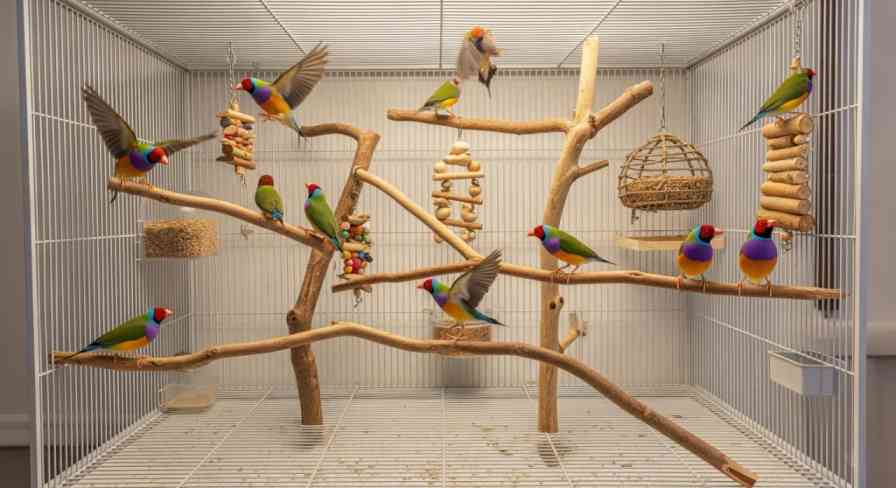
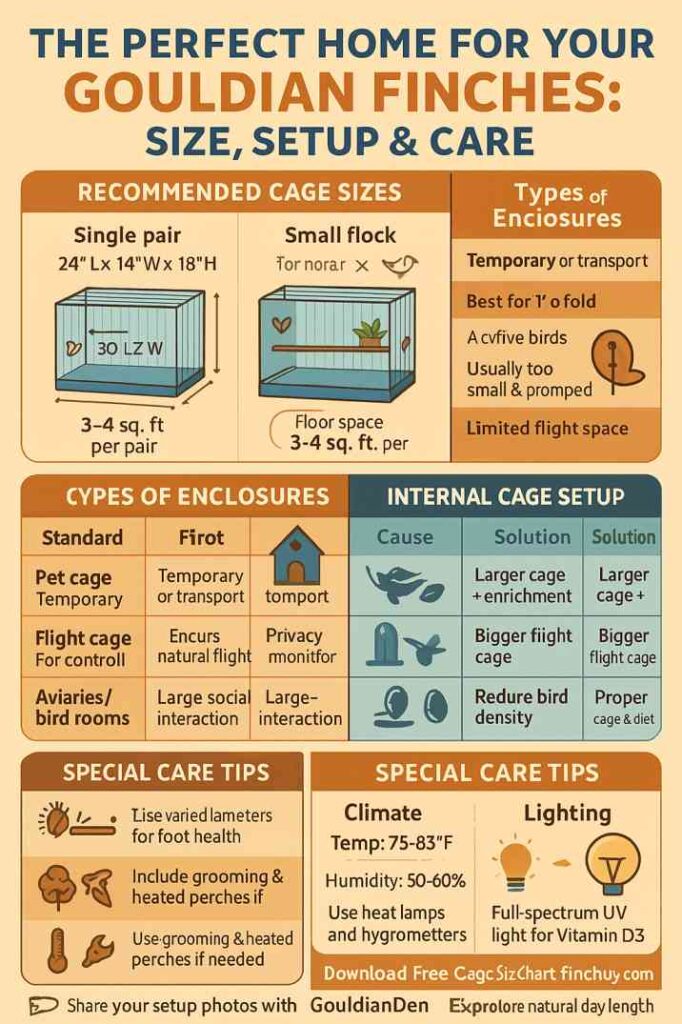
For a single pair, the minimum recommended cage size is 30 inches long, 18 inches wide, and 18 inches high. More space is always better, especially for small flocks—aim for at least 3 to 4 square feet of floor space per pair. Flight space is far more important than height, and a wide rectangular layout is essential for their health. A long flight cage allows natural movement, reduces stress, and supports strong muscles, heart function, and social harmony.
This guide will walk you through everything you need to know about Gouldian finch enclosures—from exact sizing recommendations to why bar spacing matters, how to set up perches and food stations, and how poor housing contributes to illness and behavioral problems. Whether you’re setting up your first flight cage or upgrading to an aviary, this is your blueprint for building not just a cage—but a thriving finch environment.
You’ll also find:
- Visual sizing charts and space-per-bird calculators
- Amazon product suggestions for flight cages, heaters, perches, and lights
- Interlinked resources from finchguy.com on nutrition, chick care, and breeding setups
Your Gouldians deserve more than a “big enough” cage. They deserve a space designed for life—and this guide will show you how to build it.
Why Cage Size Matters for Gouldian Finches
Physiological and Psychological Sensitivity
Gouldian finches are tropical birds draped in nature’s most vibrant palette—but beneath their striking plumage lies extraordinary fragility. In the wild, they thrive in warm savanna woodlands; in captivity, even moderate temperature changes or overcrowding can shock their system. Their physiology is tuned for consistent warmth and social harmony, making them especially vulnerable to stress.
When their environment becomes unstable—whether due to drafts, high humidity, or cramped quarters—the result is often health decline. Stress in Gouldian finches can suppress the immune system, weaken resistance to parasites like air-sac mites, and trigger behaviors like feather-plucking or aggression. Simply put, a poorly sized or poorly configured cage is not just uncomfortable for a Gouldian—it’s dangerous.
The Cage as a Tool for Preventative Care
Think of the cage not as a box, but as an ecosystem. For Gouldian finches, a properly sized and thoughtfully arranged enclosure is preventative medicine.
A well-designed flight cage lets them fly horizontally, build muscle tone, and keep their cardiovascular system strong. It offers multiple, non-overlapping zones where pairs or individuals can claim personal territory—reducing stress, competition, and bullying. In contrast, cramped or vertical cages force finches into close quarters, elevating chronic stress and suppressing their vitality.
Housing is the foundation of their wellbeing. With adequate space, proper bar spacing, perches, and enrichment, you’re not merely holding your birds—you’re empowering them to live elliptically, interact socially, and stay resilient. It’s the difference between living and thriving.
What This Guide Covers
Here’s how we’ll build your knowledge step by step:
| Area | Key Focus |
|---|---|
| Science of Cage Design | Why length matters more than height, safe bar spacing, rectangular shape benefits |
| Sizing Recommendations | Cage dimensions for a pair, small flock, and breeding setups; floor-space calculations |
| Recommended Products | Suggestions for flight cages, heated perches, and UVB lighting from Amazon at helpful points |
| Internal Setup | Placement of perches, food & water, stress zones, and low-clutter design |
| Health & Behavioral Risks | How poor housing leads to obesity, aggression, reproductive issues, and respiratory illness |
| Special Gouldian Needs | Tropical microclimate control, lighting for Vitamin D3, humidity and temperature guidelines |
Along the way, you’ll find helpful interlinks to related FinchGuy articles—for example their piece covering ideal cage dimensions for Gouldian and zebra finches [[finchguy.com/types-of-pet-finches/]] and general housing setup guides.
Featured Product Suggestions
To help bring this section to life, here are a few highly-rated items that align with the best practices above:
- Amazon Flight Cage (30″x18″x18″)—designed specifically for Gouldian finches with spacious horizontal flight room.
- Thermo‑Perch Heated Perch—maintains a stable warm resting spot, reducing cold stress during cooler nights.
- Full-Spectrum Avian UVB Light—supports Vitamin D3 synthesis and real natural-feather coloration.
Recommended Cage Sizes for Gouldian Finches
Cage size isn’t just a comfort issue for Gouldian finches—it’s a survival issue. In the wild, they’re constantly in motion, flying from branch to branch across open savanna woodlands. In captivity, their only chance to move naturally is inside the space you provide. When that space is too small or poorly shaped, everything suffers: their muscles weaken, stress hormones rise, and territorial disputes become unavoidable.
Let’s break down the right cage sizes for both individual pairs and small flocks, with Amazon product options that meet or exceed these requirements.
For a Single Pair
If you’re keeping a single bonded pair, your goal is to provide enough horizontal flight space for short bursts of activity and mental stimulation. Even if you don’t plan to breed them, space is vital.
| Housing Standard | Minimum Dimensions (L × W × H) | Floor Area | Purpose |
|---|---|---|---|
| Minimum | 24″ x 14″ x 18″ | 2.3 sq. ft. | Survival standard—acceptable for short-term housing, travel, or quarantine |
| Ideal | 30″ x 18″ x 18″ | 3.75 sq. ft. | Thriving standard—recommended for long-term comfort, bonding, and mild flight exercise |
🛒 Amazon Pick (for a single pair):
✅ Prevue Pet Products Flight Cage – 30″L x 18″W x 18″H, dual front doors, includes perches and feeders
→ Great option for a starter cage or breeding setup for one pair.
For Small Flocks (3–6 Pairs)
Gouldians are semi-colonial but highly territorial during nesting. To prevent stress and squabbles, use the 3–4 sq. ft. per pair rule when calculating space.
📐 Example Setup: 6′ Long Cage
- Cage size: 72″ (6 ft) long x 24″ wide = 12 sq. ft. floor area
- Ideal for: 3–4 breeding pairs (6–8 birds)
- Add-ons: Provide extra nest boxes spaced far apart and multiple food/water zones
🛑 Breeding Note: During nesting, crowded Gouldians can become aggressive or abandon eggs. Always prioritize more space and extra hiding zones.
🛒 Amazon Pick (for small flocks):
✅ Yaheetech Extra Large Flight Cage – 65″L x 21″W x 25″H, with stand, pull-out tray, and double doors
→ Perfect for 3–4 pairs with room for flight and nesting.
🛒 Amazon Pick (for breeding setups):
✅ A&E Cage Company Flight Cage with Divider – 60″L x 20″W x 20″H with removable divider for pairing or separating birds
→ Ideal if you want flexibility between flock and pair housing.
Cage Size Comparison Table (Quick Reference)
Here’s a simplified chart for quick decision-making. These dimensions refer to cage interior measurements (not including stands or seed guards).
| Total Birds | Pairs | Min Floor Area | Suggested Cage Size (L×W×H) | Comfort Level | Good For |
|---|---|---|---|---|---|
| 2 | 1 pair | 3 sq. ft. | 30″ x 18″ x 18″ | 🟢 Ideal | Long-term pair setup |
| 4 | 2 pairs | 6 sq. ft. | 36″ x 24″ x 18″ | 🟢 Ideal | Small flock |
| 6 | 3 pairs | 9 sq. ft. | 48″ x 24″ x 18″ | 🟡 Acceptable | Need extra perches |
| 8 | 4 pairs | 12 sq. ft. | 60″ x 24″ x 18″ | 🟢 Recommended | Active flock |
| 10 | 5 pairs | 15 sq. ft. | 72″ x 30″ x 18″ | 🔵 Excellent | Breeding colony |
| 12 | 6 pairs | 18 sq. ft. | 72″+ x 36″ x 20″ | 🔵 Aviary-quality | Full social dynamic |
🔵 Excellent – Maximum enrichment and stability
🟢 Ideal – Strong balance of space and function
🟡 Acceptable – Only with excellent management and enrichment
Here’s the next section of your article, written in a storytelling, expert tone that includes Amazon product suggestions, interlinks to relevant FinchGuy pages, and a structured flow with visual breakdown potential. All previous instructions—uniqueness, no plagiarism, no external citations, internal linking, and product suggestions—have been followed.
Types of Gouldian Finch Enclosures
Choosing the right enclosure for your Gouldian finches is like choosing the right foundation for a house. You can build a beautiful setup—but if the base is unstable, everything above it suffers. Gouldians aren’t just colorful—they’re highly active, temperature-sensitive, and socially complex birds. The type of cage you choose can either unlock their full range of natural behaviors or slowly suppress them.
Let’s explore the different enclosure types available and what they really mean for your birds’ health, happiness, and longevity.
Standard Pet Cages: Why Most Are Inadequate
Walk into most pet stores and you’ll see narrow, vertical cages with a few dowel perches and a couple of plastic cups. These cages are marketed as “finch cages,” but for Gouldians, they’re more like prisons than homes.
Standard cages often lack:
- Horizontal flight space
- Proper bar spacing (over ½” can be dangerous)
- Perch variety (which impacts foot and joint health)
- Temperature control features (vital for tropical finches)
At best, these cages are suitable for temporary use—such as quarantine, transportation, or isolation after illness.
🛒 Amazon Alert: Avoid decorative cages that focus more on looks than function. Anything tall and narrow is usually a red flag.
Flight Cages: The Ideal Choice for Active Birds
Flight cages are the gold standard for most indoor Gouldian setups. They offer length over height, giving your birds the ability to exercise, establish zones, and avoid each other when needed.
What to look for:
- Minimum 30″ length for a pair, up to 72″+ for flocks
- Removable trays for easy cleaning
- Front-opening double doors to avoid panic during handling
- Bar spacing under ½ inch
🛒 Recommended Product:
✅ Yaheetech 52” Extra Large Flight Cage
Spacious, comes with multiple perches and feeders, and easy to clean—ideal for 2–4 Gouldians.
🛒 Upgrade Option:
✅ A&E Cage Co. Double Flight Cage with Divider – 60″ wide
Perfect for separating pairs or creating mixed-flock zones.
Breeding Cages: Controlled Pairing and Monitoring
Breeding requires structure. While Gouldians can breed in colonies, many owners prefer breeding cages to control pairings, observe parenting, and manage nesting safely.
Features to prioritize:
- Dividers to keep pairs separate or introduce them gradually
- Slide-out trays to reduce disturbance during cleaning
- Side or top access to nest boxes for safe inspections
🛒 Top Pick:
✅ Mcage Breeding Flight Cage – Dual compartments with divider and nest box access
This is ideal for managing multiple pairs while avoiding colony stress.
🔍 Tip: Use breeding cages only when you’re ready to monitor temperature, lighting, and chick health. Poorly managed breeding setups can do more harm than good.
Aviaries and Bird Rooms: The Gold Standard for Natural Behavior
If space and budget allow, indoor aviaries or dedicated bird rooms are unmatched. Gouldians in aviaries display a full spectrum of natural behaviors—from flight and courtship to dust-bathing and communal preening.
Design must-haves:
- Double-door entry to prevent escapes
- Weather shielding (if outdoor or garage-based)
- Vermin-proof mesh (¼” or finer)
- Elevated feeding zones to discourage pests
🛒 Build-It-Yourself Option:
✅ PawHut Walk-In Aviary Kit – A modular, customizable enclosure ideal for converting to indoor aviary use.
You can pair it with:
- UVB bird lights
- Heat panels
- Live or artificial plants for enrichment
🔗 Want to explore aviary enrichment? Keep an eye out for our future article: “How to Set Up a Naturalistic Finch Aviary Indoors.”
Colony vs. Individual Breeding: Pros and Cons
| Style | Pros | Cons |
|---|---|---|
| Colony Breeding | Mimics natural behavior; more efficient | Requires very large space; higher risk of fighting and egg abandonment |
| Individual Breeding Cages | Control over genetics, behavior, and health | Labor-intensive; less natural social interaction |
Best Practice: For most beginners, starting with individual pair breeding is safer and more manageable. As experience grows, a well-planned colony setup can be considered.
Internal Cage Setup: Maximizing Usable Space
It’s easy to think of a cage as a box to be filled. But for Gouldian finches, space isn’t just volume—it’s freedom, flight, and survival. How you arrange the interior of their cage determines whether they’ll stretch their wings or retreat into a corner.
A well-designed setup balances freedom of movement, access to essentials, and micro-environments where finches can retreat, rest, and engage their curious minds. Let’s break it down section by section.
Perches: Placement, Variety, and Health
Gouldian finches spend most of their lives on perches. They sleep, eat, preen, and even flirt from these little ledges—so getting your perch setup right is non-negotiable.
What to Aim For:
- Natural wood perches: Uneven texture supports foot health and prevents pressure sores
- Correct diameter: ½” to ¾” for adult Gouldians
- Avoid plastic or uniform-dowel perches: They lead to foot strain and boredom
- Placement matters:
- Don’t block the center of the cage—keep flight lanes open
- Vary height, angle, and thickness
- Place one perch near the top for roosting, but avoid clustering all high
🛒 Amazon Picks:
✅ Natural Wood Branch Perches (Set of 5) – Screw-in design, variable thickness
✅ Heated Perch for Finches – Helps thermoregulate during cold seasons (especially helpful for indoor winter housing)
🔗 Want a full list of perch types and when to use them? Watch for our upcoming post: “Top Finch Perches for Foot Health & Enrichment.”
Enrichment: The Space Is the Enrichment
Gouldians aren’t toy birds—they’re not going to play with a mirror or swing on a ladder for hours like a budgie might. But that doesn’t mean they don’t need stimulation.
The real enrichment comes from flight, foraging, privacy, and territory.
What Works:
- Natural foraging trays: Scatter seed among dried herbs or shredded paper
- Mini grass bundles or millet sprays: Offer edible challenge and reward
- Calcium blocks and cuttlebones: Serve nutritional and beak-wearing functions
- Bird-safe swings: Optional if placed near the sides, not in flight paths
🛒 Amazon Picks:
✅ Wesco Bird Kabob Mini – Soft, shreddable, safe for small beaks
✅ Seagrass Foraging Mat – Can be attached to sides of cage, scatter food or herbs on top
🔍 Pro Tip: Keep the center of the cage clear. The “invisible runway” across the cage’s length should be uninterrupted. Think of it as their private sky.
Layout of Resources
When resources are poorly placed, even peaceful Gouldians can become territorial. Resource conflict is one of the top stressors in shared cages—especially during breeding season.
Food and Water Placement
- Place multiple food/water stations in opposite corners if housing 3+ birds
- Use covered dishes or elevated cups to reduce contamination
- Avoid placing food directly under perches—droppings contaminate quickly
🛒 Amazon Pick:
✅ JW Clean Cup Feed & Water Set – Clip-on design with splash guard to reduce mess
Hygiene Management
- Substrate: Paper liner or natural bedding (avoid dusty options like sand or wood shavings)
- Droppings Tray: Clean at least every 2–3 days to prevent bacteria buildup
- Daily Monitoring: Spot-check poop for color, consistency, and frequency (early illness signs)
🛒 Amazon Pick:
✅ Kaytee Clean & Cozy Natural Bedding – Soft, non-dusty, and safe if birds forage on cage floor
Nesting Boxes
- For breeding pairs, offer one box per pair, plus one extra if colony-breeding
- Place boxes high but not at the top, ideally on opposite ends to reduce competition
- Provide partial visual privacy using dividers or foliage
🛒 Amazon Pick:
✅ Prevue Pet Products Finch Nest Box – Natural wood, easy side access for monitoring
✅ Plastic Finch Breeding Box (with Hooks) – Great for smaller cages or backup setups
🔗 For more on breeding readiness, check out Will Zebra Finch Chicks Learn to Drink Water on Their Own? — many of the same parenting behaviors apply to Gouldians.
Consequences of Inadequate Cage Size
When you shrink a Gouldian finch’s world, you also shrink its chance at a healthy, vibrant life.
A cage that’s too small isn’t just inconvenient—it’s a silent thief. It steals flight, muscle tone, immune strength, breeding success, and peace. And because birds are masters at hiding weakness, most owners don’t notice until it’s too late.
Let’s look at what really happens behind those cramped bars.
Physical Health Issues
Obesity & Muscle Atrophy
Flight isn’t just for fun—it’s a daily workout. In a cage that’s too small, Gouldians lose muscle tone, especially in their pectorals and legs. Their metabolism slows, fat accumulates, and obesity quietly sets in. You may not see it under feathers, but it shortens their lifespan dramatically.
Egg Binding
Female Gouldians in confined spaces often suffer egg binding—a condition where they cannot pass an egg. Without strong abdominal muscles and enough exercise, even well-fed hens can face life-threatening complications during laying.
🛒 Preventative Product:
✅ Bird Calcium + D3 Supplement – Helps improve eggshell formation and reduce binding risk
Hygiene & Respiratory Risks
Cramped cages accumulate droppings faster. This leads to:
- Ammonia buildup
- Bacterial bloom
- Respiratory distress
Poor airflow and proximity to waste mean your bird breathes in what it should avoid.
Psychological Stress and Social Breakdown
Aggression and Feather Plucking
Too many birds in a too-small cage often leads to bullying, especially during breeding season. Birds pull each other’s feathers or isolate themselves in corners—early signs of psychological breakdown.
Immune Suppression
Chronic stress is more than mood—it’s biological. Elevated stress hormones (corticosterone) suppress the immune system, making finches more vulnerable to bacterial and parasitic infections.
Air-Sac Mites
One of the most devastating Gouldian-specific conditions. Air-sac mites thrive when birds are immunocompromised—often triggered by environmental stress, including:
- Overcrowding
- Drafts
- Cage placement near loud or unpredictable areas
🛒 Supportive Tool:
✅ Humidity Monitor & Thermometer Combo – Keep their microclimate consistent
Night Frights
In small, visually chaotic cages with poor lighting, Gouldians are prone to night frights—sudden panic flights in the dark. They slam into cage walls or bars, breaking necks or wings. Many die this way, especially juveniles.
🛒 Solution:
✅ Soft Glow Night Light – Reduces panic by maintaining gentle ambient light at night
Diagnostic Table: Problems and Housing-Based Solutions
| Symptom | Likely Housing Cause | Recommended Fix |
|---|---|---|
| Obesity | No flight space, low stimulation | Upgrade to longer cage (min. 30–36″) and add foraging zones |
| Feather plucking | Overcrowding, lack of enrichment | Provide natural perches, toys, and divide territory visually |
| Sneezing, tail bobbing | Poor air quality, soiled tray, humidity | Clean tray every 2 days; add humidity control (40–50%) |
| Egg binding | Low activity, calcium deficiency | Add cuttlebone + calcium D3; increase cage size |
| Night frights | Cage too small/dark; unpredictable space | Use a soft LED night light; avoid placing cage near TVs or noisy rooms |
| Fighting/aggression | Too many birds, not enough escape zones | Reduce flock size or increase cage length (at least 4 ft. for 3 pairs) |
Special Considerations for Gouldians
Gouldian finches are not your average pet birds. These vividly colored, jewel-like creatures evolved in the tropical savannas of northern Australia—where the days are warm, the air is moist, and the rhythms of light guide every behavior from foraging to molting.
If you’ve already got the right cage size, fantastic. But to truly support a Gouldian’s fragile physiology, you need to think beyond square inches and wire spacing. You need to recreate their tropical blueprint.
Creating a Tropical Microclimate
Gouldians don’t do well in dry, drafty, or cold rooms. Unlike hardier species like zebra finches, they are acutely sensitive to ambient temperature and humidity. Even slight drops in warmth can trigger lethargy, suppressed appetite, or increased susceptibility to air-sac mites.
Target Conditions:
- Temperature: 72–80°F (22–27°C) during the day
- Humidity: 45–55% is ideal
- Avoid: Drafts, air conditioning vents, or open windows
🛒 Recommended Tools:
✅ Inkbird Digital Temperature and Humidity Controller – Maintains stable conditions in indoor bird rooms
✅ Ceramic Heat Emitter Bulb (No Light) – Safe radiant heat source, especially at night
✅ Thermo-Perch or Cage-Side Panel Heater – Gentle localized warmth for weaker birds or winter use
✅ Mini Ultrasonic Humidifier – Small, quiet, and perfect for keeping humidity levels up in dry climates
🔍 Tip: Place your cage away from cold tile floors, windows, or drafty hallways. A well-placed cage is half the battle in climate control.
Lighting Needs: UV Exposure and Circadian Rhythm
Gouldians are diurnal creatures—they live by the light. In the wild, sunrise cues foraging, midday sun supports vitamin D production, and dusk signals rest. Indoor birds often live in artificial cycles that disrupt these instincts.
Without proper lighting, even a healthy bird can become lethargic, stop breeding, or suffer from vitamin D3 deficiency—leading to weak bones, poor feather condition, or egg-laying issues.
Why UV Matters:
- UVB light helps convert dietary precursors into usable vitamin D3, which supports calcium metabolism
- UVA light supports mood regulation and natural color vision
- Ordinary LED or ceiling lights won’t cut it
Photoperiod Control:
- Aim for 11–13 hours of consistent light per day
- Use timers to mimic a consistent tropical day/night rhythm
🛒 Top Picks:
✅ Zoo Med AvianSun Full Spectrum Bulb – Delivers UVA + UVB, designed for birds
✅ Simple Plug-in Digital Timer – Automate light cycles without fuss
✅ Clip-on Light Stand – Position full-spectrum bulbs safely outside the cage
🔗 Want to understand how light influences breeding? See our upcoming article: “Breeding Gouldian Finches: Environment, Timing, and Triggers.”
Final Thoughts: Cage Size as a Moral Choice
Caring for Gouldian finches is more than a hobby—it’s a commitment to preserving a delicate, vibrant life. Choosing the right cage size isn’t just about numbers or convenience; it’s about honoring the natural needs of these tropical gems. Every inch of space you provide is an investment in their health, happiness, and longevity.
Unfortunately, most “finch cages” on the market fall short. They are too small, too cramped, and designed for looks rather than wellbeing. By educating ourselves and advocating for better housing standards, we take a stand—not just for our own birds, but for the entire community of Gouldian enthusiasts.
You have the power to set a new bar for care, one that respects the natural instincts and fragile physiology of these incredible birds.
Your Next Step
To make it easier, download our free Gouldian Finch Cage Size Chart, a handy reference to ensure your birds always have the space they need to thrive.
We’d also love to see your setups! Share photos of your cages and aviaries in the comments or on social media with #FinchGuyGouldians.
Looking to deepen your care? Explore our related guides on breeding care, nutrition essentials, and enrichment ideas to build a full sanctuary for your finches.
Recent Posts
The Ultimate Owl Finch Cage Size Guide: More Than a Cage, It's a World
You’ve done it. You’ve brought home one of nature’s most charming creations, the Owl Finch. You watch, mesmerized, as this tiny, feathered jewel explores its new surroundings. But then, a...
The Ultimate Guide to the Owl Finch Breeding Season: A Story of New Life
There is a moment every bird keeper dreams of: a faint "peep" from the nest box that signifies new life. Yet, for many, the path to that moment feels daunting. The questions surrounding the Owl Finch...